
It is hard to focus on threats that can't be sensed when there is so much visibly wrong. The people in L.A. suffering the devastating wildfires have seen the raging fires. They have heard the crackle of homes being burned. They've smelled the smoke and dust. They've felt the heat and tasted the embers in the air.
Videos by Wide Open Country
So it's no wonder that the invisible threats have lay undetected. Yet they are just as pressing as the frenzied fire.
WOC had the privilege to speak with Armen Araradian of IQAir about how the wildfires have impacted air quality, what that means for the people of L.A., and what can be done about it. He lives in L.A. and has experienced the horrors firsthand.
IQAir's mission is to spread awareness and knowledge about air quality. Through the use of Air Visual, we can track the air quality of the planet we're living in live from their website. They use over 30,000 monitors to achieve this.
Alongside the smoke, the wildfires are throwing out invisible streams of harmful pollutants, ones that are so small that "They can penetrate the layers of the cell wall and harm every cell in the human body."
PM2.5 Particles Will Work Under The Wildfires' Large Shadow, And After The Fires Have Been Put Out
PM2.5 particles are incredibly small. "A human hair is about 50 to 100 times larger in diameter than one of these cells," says Araradian.
"PM2.5 is the most dangerous of all the major six pollutants," he said. "The particles are so small that they can go deep down into your lungs" and "affect deep tissue."
This causes a "whole host of health concerns that affect every cell in the human body."
PM2.5 particles are not unique to wildfires but are produced heavily alongside other pollutants and smoke. The worst part is that these particles don't go away as easily as the smoke does.
Even after the smoke has stopped and the fires have calmed down, not all threats have been quelled. When the wildfires are beaten back, there is still danger lurking in the air. At least we can fight the fires; we can't simply clean the air.
Araradian highlighted that winds are the be-all of wildfires and the end-all of pollutants. Although the strong winds spur on wildfires, they also "act like a fan" and drive away the lingering pollutants.
However, IQAir has observed that the winds have been blowing pollutants from the fire into the parts of the city untouched by the physical flames. The damage of a wildfire extends much past what it touches. The pollutants it bellows get blown by the wind to assault the city beyond.
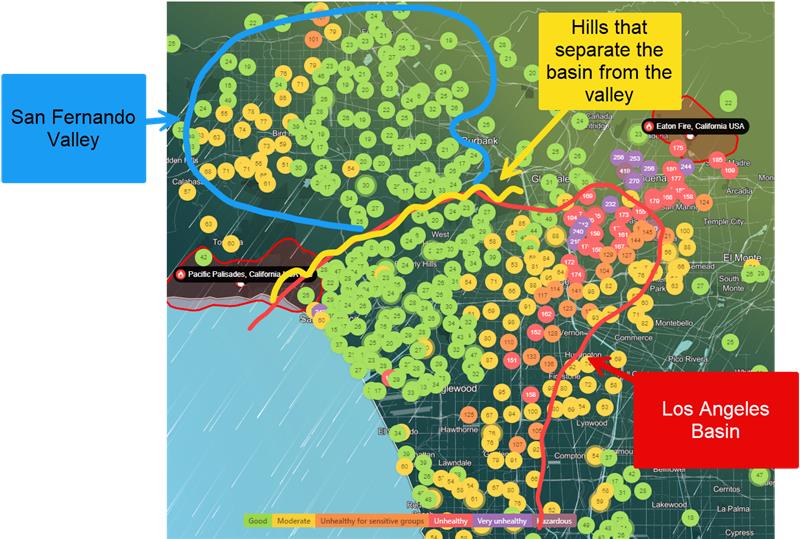
Above is a map of air quality in L.A. amid the wildfires. The wind was observed directing the pollutants from the Eaton Fire across the rest of the city, where it struck through like a dagger.
Just because you aren't near a wildfire, doesn't mean it's not affecting you.
All We Can Do Is Prevent Wildfires Happening In The First Place
So long as there are wildfires, there will be masses of harmful pollutants hurting those near and far. An invisible plague that only gets worse as more fires start.
You're probably sick of it by now, but climate change is the leading cause of "more frequent and more severe weather events."
"What happened in Los Angeles is our future if we don't take real, actual steps to solve the climate crisis," warned Araradian. "If we don't act on the climate, the climate is going to act on us. And we've already seen that start to happen."
According to the World Health Organization, 7 million people die from pollutant exposure each year.
So, what can we do?
Araradian believes the best weapon against PM2.5, and pollution in general, is awareness. "If you don't know what you're breathing, you don't know how to keep yourself protected," he said. "You don't know how to ask your elected official to make some sort of change based on what is hyper-local to your area."
IQAir uses over 30,000 monitors to track air quality around the world. The technology is free to access on their website. Knowledge is power, after all.