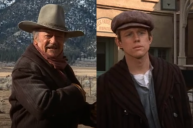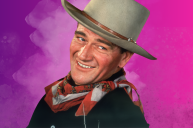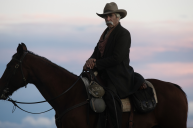
Ron Howard is looking back at his experience filming a movie called The Shootist. Released in 1976, it had a stellar cast led by the iconic John Wayne. Howard, who is 72, has warm recollections of the star. Sadly, that was his final film. He died in 1979 at the age of 72. Howard recalls that the actor was friendly to him, even though he was embroiled in an ongoing battle with director Don Siegel.
Videos by Wide Open Country
Speaking with host Ben Mankiewicz on the Talking Pictures podcast, Howard said this. "I...learned a lot in a rather uncomfortable way, because Wayne and Siegel were feuding. They did not get along. And I was getting along with both of them separately, just fine." Ron Howard, having graduated from his role on The Andy Griffith Show, was 22 at the time.
Wayne Apparently Admitted Howard Into His "Very Closed Little Bubble'
The easygoing young actor was seemingly welcomed into John Wayne's small circle of people close to him. Howard, for his part, had the audacity to approach Wayne. "And I also had the guts to say, 'Hey, do you want to run lines?' No one really would talk to him in between setups. He had a couple of people: a guy he would play chess with, who was the still photographer who had worked with him on a lot of films. But it was a very closed little bubble that he was operating in."
Furthermore, Ron Howard mentioned, "He was perfectly friendly to me, and he said, 'Yeah, I'd like to run lines.' And we had a lot of scenes together, heavy dialogue, and it was very interesting to see him take a scene and shape it into a John Wayne performance in the most positive ways."
The Youthful Actor Did Take Issue With the Way the Director Handled Onset Tiffs
Howard would one day be a very successful director himself. Nevertheless, he did find Don Siegel's method of dealing with actors like Wayne somewhat lacking. He noted, "...[I]t was pretty intense, but I remember saying, 'There's a better way to deal with even superstars than this.'"
He learned how to best handle onset antagonism. That is, address it directly before it explodes. Such a strategy tends to defuse the ill will. Howard clarified, "The strategy that I've followed over the years is when there's a difference of opinion, go right into it. You don't have to make it a fight, but you're there to achieve something together and talk it through."
Howard also observed, "Don't let it become something that's petty and emotional when, in fact, it's a creative concern or a neurotic concern. And if you shine a bright light on a neurotic concern, most people, even the most neurotic of them, say, 'Oh yeah, I guess I was a little insecure about that.'"