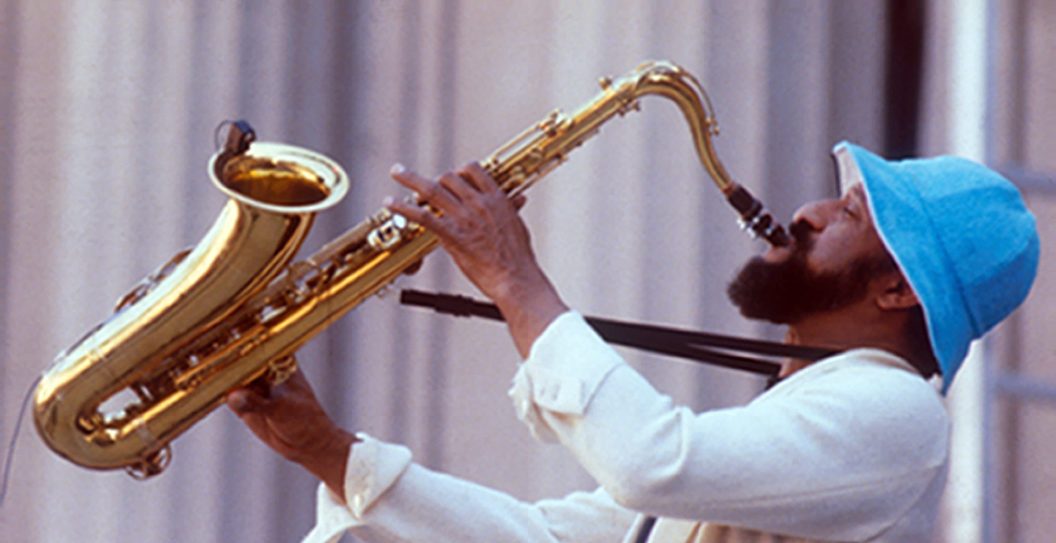
Sonny Rollins has died at the age of 95.
Videos by Wide Open Country
The news was confirmed by a social media post by his family and then reported by Variety. The cause of death of the jazz legend has not been shared.
Known as the "Saxophone Colossus," Rollins was a groundbreaking artist who went head-to-head with John Coltrane on the title track of his 1956 album Tenor Madness.
Sonny Rollins Was a Jazz Visionary
Born Theodore Walter Rollins in Harlem on September 7, 1930, the musician began playing piano and alto saxophone before taking up the tenor. It was his desire to emulate his idol Coleman Hawkins, who lived in Rollins' neighborhood, that influenced this transition.
A classmate introduced Rollins to Thelonious Monk, who would become a strong influence on his work. Then, at 18, the saxophonist made his recording debut in 1949 with a band led by trombonist J.J. Johnson. This opportunity led to sessions with pianist Bud Powell, the Modern Jazz Quartet, Monk, and trumpeter Miles Davis. In 1954, Davis recorded three of Rollins' compositions.
Rollins Confronted His Addiction
Around this same time, Rollins was dealing with a heroin addiction. He was arrested and jailed on drug charges in 1950. He went back in 1953 for violating parole. It was Davis who encouraged Rollins to clean up. In 1954, the saxophonist kicked his habit in a federal drug facility in Lexington, Kentucky.
After his recovery, Rollins' career really took off. In 1956, he led Davis' band (minus Davis) on Tenor Madness and also recorded the album that bears his moniker, Saxophone Colossus.
But after a string of successful albums through the 1950s, Rollins stepped away from the spotlight. He practiced in private. An article then revealed Rollins could be seen and heard playing on the Williamsburg Bridge in New York City. A 1977 commercial for Pioneer Electronics reenacted this period.
"I found it's a superb place to practice," he said. "Night or day. You're up over the whole world. You can look down on the whole scene. There is the skyline, the water, the harbor. It's a beautiful scene, a panoramic scene...You can blow as loud as you want. It makes you think. The grandeur gives you perspective."
Legendary (and lucrative) albums then followed. Among his notable works, Rollins' saxophone can be heard on the 1981 Rolling Stones' classic "Waiting On a Friend."
Rollins Achieved a Different Kind of Fame in 2001
Rollins achieved a different kind of fame years later, when he was spotted with his saxophone leaving a building near the World Trade Center on September 11, 2001.
"When we were evacuated the next day, I had my horn with me," explained Rollins. "People were looking at me strangely, because with all the police and ambulances and trucks and the army, it was like a World War II movie — and here's me, this guy in a beret with a saxophone."
Rollins would then win a Grammy for Jazz Instrumental Solo for his performance of "Why Was I Born?" at a concert in Boston just days after the attacks.
Rollins later received a National Medal of the Arts, a Kennedy Center Honor, and an honorary degree from Juilliard. Also, his 1962 album The Bridge was inducted into the Grammy Hall of Fame in 2015.