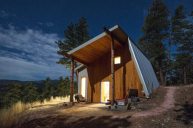
One house was lucky enough to survive the LA wildfire compared to its neighbors, but was it really luck? A picture of Greg Chasen's unscathed house went viral online amid the Palisades wildfire destruction. This house's survival is due to smart design choices considered to be passive house construction.
Passive House Design Saves Home From LA Wildfire
"Some of the design choices we made here helped," Chasen wrote about his house on Iliff Street. "But we were also very lucky." But what are passive house designs?
Chasen went into detail online on many passive design choices that saved his house from the raging wildfires. The architect mentioned the "solid concrete perimeter wall" that probably saved them, as well as "no vents or eaves and tempered glass windows." Mansion Global explained that having no eaves can prevent embers from catching on them.
According to the outlet, passive house standards are a "construction method focused on minimizing the energy footprint of a structure and which has also proven to be more fire resistant than typical construction methods." This, alongside an "efficient air ventilation system known as HRV (heat recovery ventilation)" can protect the house from the elements.
These ideas come from Ken Levenson, the executive director of the Passive House Network. Based in New York, the PHN provides education for architects and builders with a focus on cutting building carbon emissions.
It's unclear whether Chasen, who just finished constructing the home six months ago, built it with passive house standards in mind. Nevertheless, it definitely follows similar principles. These buildings focus on a compacted form to stop embers from catching, alongside airtightness with only a few vents.
This way, there are fewer entry points for embers to get inside the house. Reinforced windows also help seal the house. Mansion Global also explained how passive homes are wrapped in less-flammable and more sustainable types of insulation like "mineral wool or wood fiber board manufactured with borates."
Despite constructing a home with similar designs in mind, the fact that his home still stands shocked the homeowner. "I'm kind of in shock and I just feel terrible for the neighbors," Chris, the homeowner, told NBC4 LA. "We're very lucky that the house survived."
Chris' family owned the property since 1998, but Chasen completed the rebuild in 2024. Hopefully, once California recuperates and rebuilds, it will consider creating more houses like this one to withstand future wildfires.