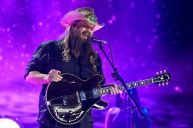

Chris Stapleton is a country music star because of his immense singing and songwriting skill. He is not, however, someone who likes to stir the pot, so to speak, by embracing or sparking controversy in his music. In fact, he seems to shun that. When he was a guest on Armchair Expert with Dax Shepard, the celebrated Grammy winner explained why he deliberately dodges subject matter that elevates the social temperature.
Videos by Wide Open Country
Some Artists Invite Controversy but Not Him
Some songwriters and vocalists apparently seek controversy. Chris Stapleton, 47, said on the podcast that "That's part of their thing. And some people wanna discuss things that aren't about music or make that part of their thing, and it's not part of my thing."
One country music singer whose name came up in Stapleton and Shepard's chat was Jason Aldean. For example, his song, "Try That in a Small Town," raised more than a few hackles. There were listeners who interpreted it as racially insensitive or advocating vigilanteism. Aldean defined its message quite differently. He firmly stood by the song.
Aldean and his provocative stances rankle some members of the public. "People almost lit our studio on fire for having Jason Aldean on," Dax Shepard acknowledged. Stapleton, however, is seemingly at the other end of the spectrum.
Stapleton Has Other Artistic Goals Besides Stoking Division
The podcast's co-host, Monica Padman, emphasized that their show is not about "contribut[ing] to the divide." She said, "We're here to, like, show humanity." Her remark struck a chord with the country icon and he elaborated on that point.
Stapleton noted, "I think that's an important thing to want to connect to. But I also think in a musical space, my job is to connect to the music and then put that out in the world and let people find themselves in it."
He also clarified what, in his opinion, breathes life into a song. "No song means anything until it goes out into the world and people hear it and attach themselves to it and find themselves in it. Or it marks a point in their life. That's it. [The song] has zero meaning until that happens."
He Recognizes and Values the Unifying Power of Music
He sees the ability of music to bring people together and let them know that whatever they are experiencing, others are feeling too. "The magic point to me is in regards to a certain type of song, but people like sad songs. So they don't feel alone. And I think maybe all songs are that way. And then we wanna feel those emotions together. There's a communal thing in that."