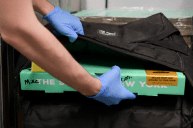

A family in Southampton, England, got far more than they bargained for while clearing out a garage ahead of a house move.
Videos by Wide Open Country
George Cheetham, 26, was helping his grandmother, Pam Heritage, sort through belongings left behind by his late grandfather, John Heritage, when he stumbled across two anti-aircraft shells dating back to 1916.
The discovery quickly turned from an interesting historical find into a potentially dangerous situation.
The family quickly realized the shells still appeared to be intact.
Bomb Squad Called After Family Discovers World War I Shells
The century-old shells were found among John Heritage's extensive collection of belongings.
"It's mainly my grandad's stuff that's in [the garage]," Cheetham said. "He passed away last year, but he was a hoarder so we need to get the garage cleared."
"I came across [the shells] and I pulled them out," he continued, "and they still had the tops on and were really heavy, so me and my nan were like, 'S---.' "
Concerned that the devices could still be dangerous, the family contacted Hampshire Police.
Officers attended the property, examined the shells, and took photographs before calling in the British Army's Explosive Ordnance Disposal team.
Specialists from the EOD unit X-rayed the devices and made the startling discovery that both shells were still live.
World War I Explosives Safely Destroyed
Following the examination, the shells were carefully transported to a nearby field, where experts carried out a controlled disposal operation.
Authorities later confirmed the devices were "safely disposed of by explosive demolition."
Cheetham believes the shells may have belonged to his great-grandfather, who served in the Royal Navy during World War I.
"I remember him passing me some shells when I was younger, but that was 20-something years ago," George reminisced. "We had all forgotten about them for like 20 years, and Grandad probably forgot about them, too. On the bottom of the shells, they're dated. One was '3rd of July 16,' and then the other one said '1916' on it."
Although relieved the situation ended safely, Cheetham admitted he was disappointed to lose a piece of family history.
"But it's better getting rid of them than your nan getting blown up," he added.
He said his grandmother "found it funny" that they had unknowingly been standing in their garden with two live World War I artillery shells more than 100 years old.
A spokesperson for the British Army later confirmed that an EOD team from 721 Squadron, 11 EOD&S Regiment RLC, responded to the incident on May 16.
"The EOD Operator identified two 2lb anti-aircraft rounds from WW1, which were safely disposed of by explosive demolition," the statement read.