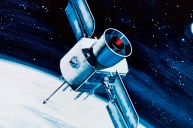

A 1000-pound Soviet spacecraft, Kosmos 482, was supposed to travel all the way to Venus back in 1972. However, an engine failure caused it to remain in Earth's orbit for more than 53 years. May 2025 will now see Kosmos 482 re-enter Earth's atmosphere.
Videos by Wide Open Country
According to EarthSky.org, Kosmos 482 originally departed Earth back on March 31, 1972. Its original mission was to become a Venus probe, with equipment ready to withstand the hostile planet. However, an issue with a timer caused one of its engines to be cut off prematurely. This caused the spacecraft to remain in Earth's orbit for 53 years.
After decades of circling Earth, Kosmos 482 is expected to impact an unknown part of Earth from May 8 to May 11. The exact place where it will fall is just one of the many things that are not clear at this time.
For example, it is unclear whether the spacecraft will be seen as a fireball as it enters Earth's atmosphere. Moreover, the place of the impact is also something of a mystery, with the Kosmos's orbit determining that it could land anywhere between latitude 52 degrees north and 52 degrees south, as per the site.
Impact
Given that Earth is mostly oceans, it is very probable that Kosmos 482 will land on water. However, the spacecraft could also impact a populated area, which could be problematic. Given its weight, the Soviet spacecraft could impact Earth at around 150 miles per hour. While astrophotographer Ralf Vandebergh observed the spacecraft with a telescope and detected that there might be a parachute attached to Kosmos 482, chances are it won't slow the spacecraft after reentry.
Many factors will contribute to determining the exact day of Kosmos 482's return to Earth. One of them includes the sun's activity, which can impact the spacecraft's orbital speed. Therefore, we could expect Kosmos 482 to impact Earth anywhere between May 8 to May 11. As the coming days pass, experts will be able to determine both the date and place of impact.
Given the necessary conditions, people on Earth could be able to see the probe reentering Earth's atmosphere.